
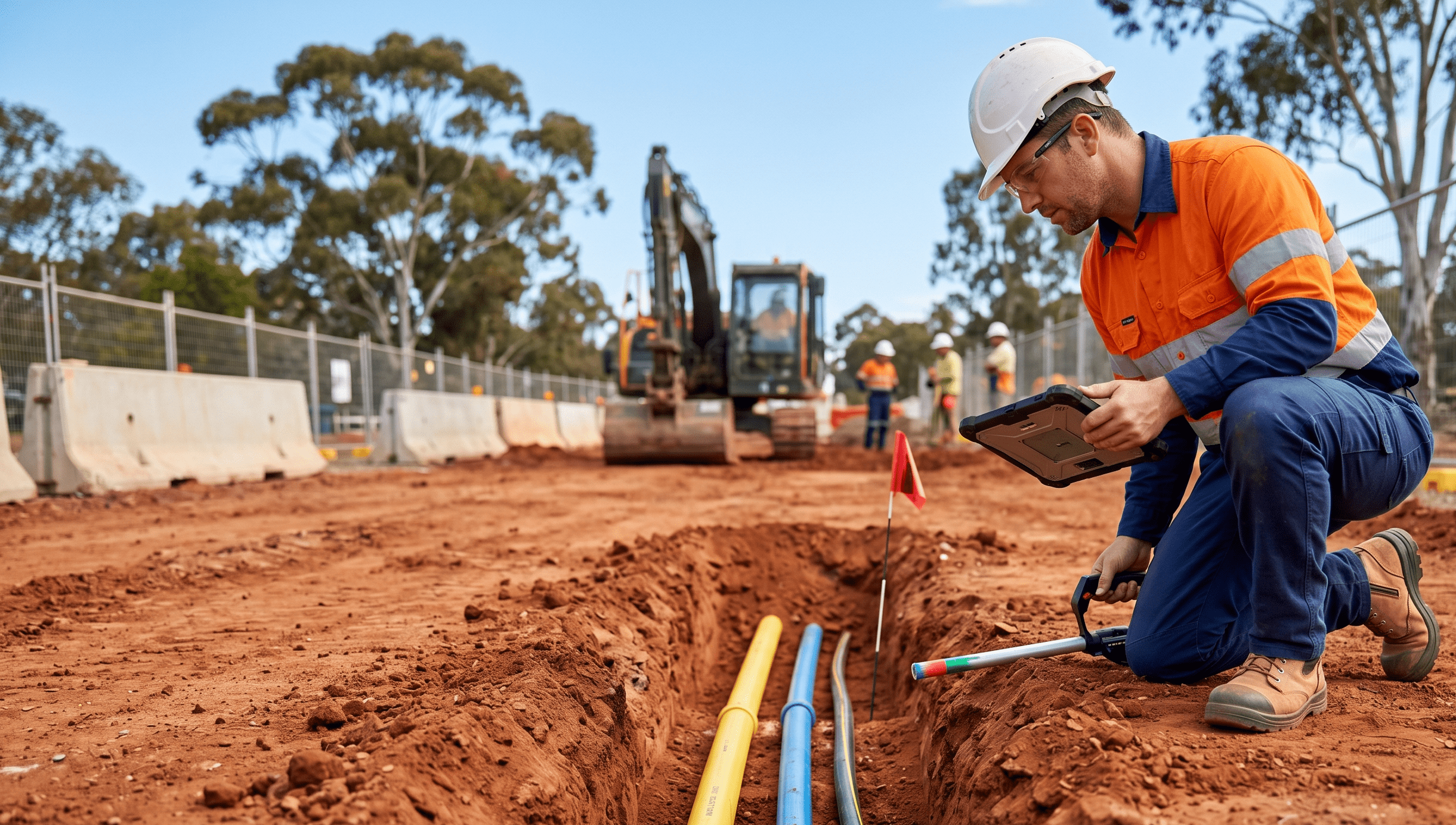
Strikes feel like bad luck on site. The bucket drops, something gives, and the day stops. But when you look at the national data, luck has very little to do with it. The same causes show up again and again, and almost all of them are fixable before anyone starts digging.
Before You Dig Australia now runs a Damage Data Dashboard that collates utility strike incidents across the country. Their 2024 research, Economic Assessment of Utility Strikes in Australia, used that data to find the root drivers. The conclusion was blunt. Most strikes are not freak events. They come from a small set of repeatable failures.
Here is what the data says, and what a NSW project manager can do about each one.
Three causes sit behind most strikes
BYDA’s research tied the bulk of incidents to three things: outdated regulation, low data standards, and insufficient training. BYDA CEO Mell Greenall framed the national bill, close to $5 billion a year, as preventable damage rather than accidental damage.
That word matters. Preventable means the cause is known. Each of the three drivers points at a control that a site team can apply or demand.
The plans you trust are the first failure point
The most common assumption on a NSW site is that a BYDA referral tells you what is in the ground. It does not. BYDA is a notification service. It refers your dig site to asset owners who then send their plans. BYDA holds no plans itself, and the quality of what comes back depends entirely on each owner’s records.
Two gaps follow from this.
First, not every asset owner is a BYDA member. Private services, older subdivisions, decommissioned-but-live assets, and infrastructure owned by parties outside the referral system simply will not appear. If you treat the plan pack as complete, you are digging blind over everything it left out.
Second, the plans that do arrive are often wrong about position. They show where an asset was meant to go, not where it ended up after the install crew moved it around a rock or a tree root twenty years ago. The move from Dial Before You Dig to the BYDA system improved the front end, but it did not change this. Plans are a starting point. They are not a locate.
Bad data is the quiet culprit
This is the cause that gets missed because it does not look dangerous. It looks like a PDF.
BYDA’s research found that utility location data across Australia is often low quality, out of date, and delivered at Quality Level D. Under AS5488, the standard that governs subsurface utility information, Quality Level D is the lowest tier. It means the information came from existing records alone, with no field verification at all. No locate. No survey. Just a drawing.
So the typical starting point for a NSW excavation is a flat PDF showing assets at the least reliable quality level the standard defines. Better data exists. Engineering-validated as-builts, surveyor reports, and field locator information all sit higher up the AS5488 scale. But the industry keeps planning off the bottom rung.
If you want to understand why this matters for your own scope, the difference between the AS5488 quality levels is the whole story. A QL-D plan tells you a service might be near. A QL-B locate tells you where it is in plan. A QL-A pothole tells you exactly where it is, in three dimensions, with your own eyes on it. Strikes happen in the gap between D and B.
Civil construction sits at the top of the cause list
The BYDA data, presented at a 2024 utility safety workshop run with the Civil Contractors Federation NSW and SafeWork NSW, named civil contractors as the most likely group to cause a strike, with homeowners a close second. By state, NSW recorded around 5,100 strikes, second only to Victoria.
This is not a reason for the industry to feel singled out. Civil contractors run the highest volume of mechanical excavation in the most congested ground, so they sit at the top of the list by sheer exposure. But it does mean the responsibility to break the pattern sits with the same group. The sector causing most strikes is the sector best placed to prevent them.
What prevention actually looks like
The data points at causes. The fix is a sequence, and none of it is exotic. It is the difference between assuming and verifying.
- Lodge BYDA, then treat the result as incomplete. Use the referral to learn what should be there. Assume private and non-member assets are missing until proven otherwise.
- Locate before you dig, not after. Run underground utility locating across the work area with both electromagnetic and ground penetrating radar coverage. One method finds conductive services. The other finds non-conductive and unrecorded ones. Congested NSW corridors need both.
- Lift the data quality before design locks in. Push the information up the AS5488 scale from QL-D toward QL-B at the planning stage, so the design is built against located reality rather than a hopeful PDF.
- Pothole the crossings that carry risk. Non-destructive digging exposes a confirmed service to QL-A before any mechanical plant goes near it. This is the single control that prevents the most expensive strikes.
- Maintain clearance and communication on site. The dashboard cause data keeps returning to operators digging too close and teams not talking. A daily pre-start that names every located service, marked and understood by the operator, closes that gap.
- Train for it. BYDA tied a share of strikes to inadequate training. Crews who understand what the marks mean, and what the locate did not cover, dig differently.
Each step removes one of the failures the data keeps finding. Skip them and you are betting the programme on a Quality Level D guess.
The pattern is the opportunity
The encouraging part of the BYDA research is that the causes are consistent. Consistent causes can be designed out. A site that lodges BYDA, locates with the right methods, lifts the data above QL-D, potholes the key crossings, and runs a tight pre-start has removed almost every failure the national data records.
The strikes that still hurt NSW projects are not mysteries. They are the jobs that trusted the plan and skipped the verification. The data has been clear on that for years.
If you want a locating and verification scope built around the real risk on your site, not the gaps in a PDF, talk to the Smartscan team. We will tell you what the plans are likely to miss and how to find it before the bucket does.