
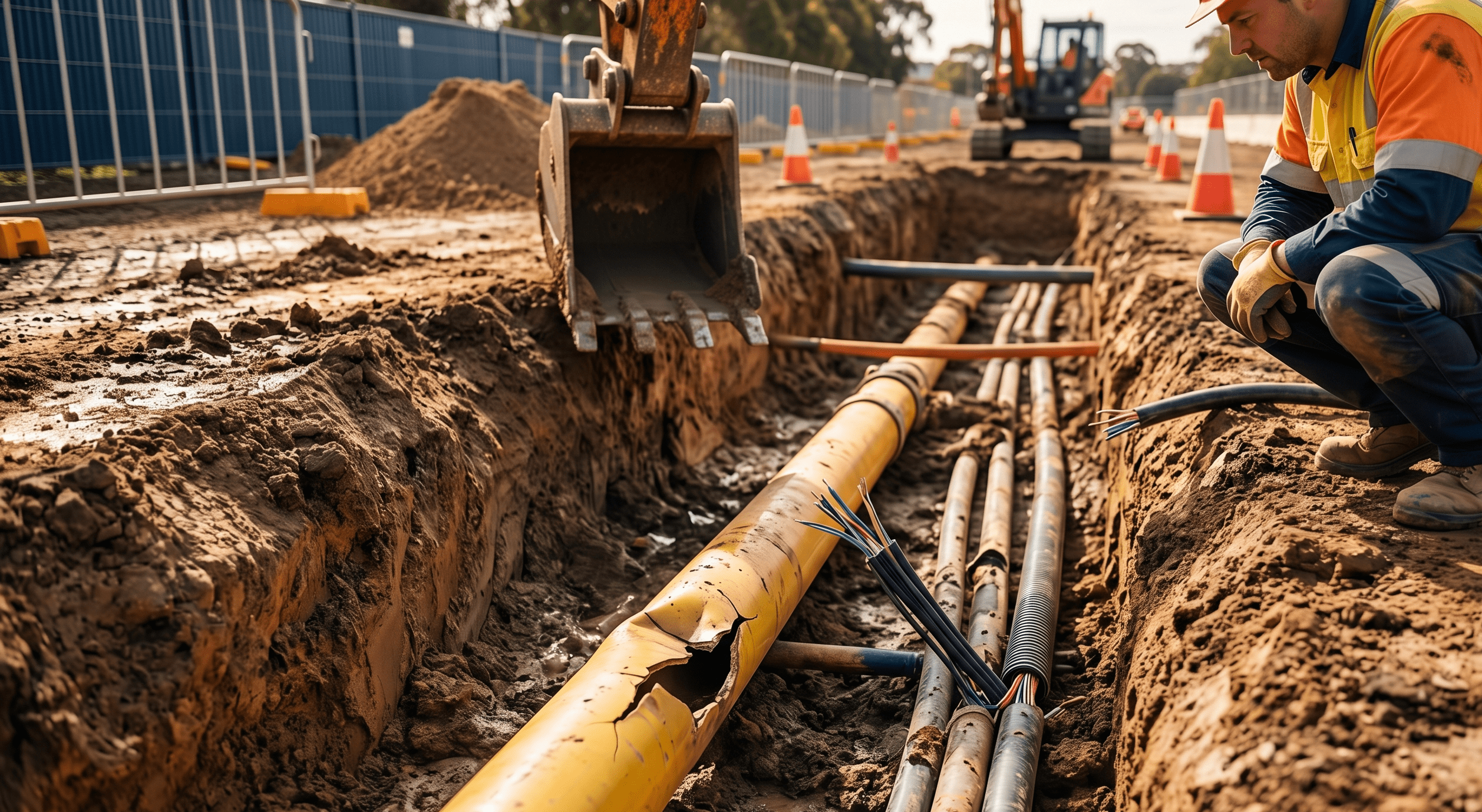
Ask most site teams what a utility strike costs and they will point at the repair bill. A hit gas main, a severed Telstra cable, a punctured water main. Fix it, claim it, move on.
That number is the smallest part of the cost. The repair is the tip. Everything under the waterline is bigger, and on a NSW civil project it lands on the project manager.
Before You Dig Australia put real figures to this in 2024. Their report, Economic Assessment of Utility Strikes in Australia, was the first national study of what these incidents actually cost the country. The headline is hard to ignore: strikes cost Australia about $4.6 billion every year in direct and indirect damage. More than 15,000 of them happen annually. This is not a rare event. It is a recurring tax on poor planning.
The repair bill is the part you can see
When a cable or pipe is struck, the direct cost is the physical repair. Parts, labour, the asset owner’s crew, the make-safe. For a low-voltage cable that might be a few thousand dollars. For a high-pressure gas main or a high-voltage feeder it climbs fast.
But the direct repair is rarely the line item that hurts. The University of Birmingham research that informed the BYDA study looked at fully documented strike case studies and found the indirect and social costs ran far higher than the repair itself. Across those cases the total cost worked out at roughly 29 times the direct repair figure. A strike with a $10,000 repair was not a $10,000 problem. By the time everything was counted, it was closer to $290,000.
That multiplier is the part site teams forget to budget for.
Where the real money goes
The costs under the surface fall into a few buckets, and a project manager carries most of them.
Crew and plant standby. When a strike stops work, the excavator does not stop costing money. The crew, the supervisor, the hired plant, the traffic control, all of it sits idle while the area is made safe and the asset owner attends. A day of standby on a mid-size civil crew runs into thousands before anyone touches the actual repair.
Programme delay and liquidated damages. Most tier 1 and tier 2 civil contracts carry liquidated damages for late completion. A strike that pushes a critical path activity can trigger that clause. The daily or weekly value depends on the contract, but on infrastructure work it is routinely in the tens of thousands per week. One bad strike near a milestone can wipe out a job’s margin.
Service interruption claims. This is the cost that scales out of control. Cut power or telecommunications to a hospital, an exchange, a data centre, or a strip of businesses, and the loss-of-service claims dwarf the repair. The asset owner passes those through. The party that dug carries them.
Investigation and prosecution. A serious strike in NSW can draw a SafeWork NSW investigation, especially where there was a near miss or an injury. That means site shutdowns, document requests, legal time, and potential enforcement action. The cost of the investigation alone, in lost time and legal fees, often outweighs the repair.
Insurance and reputation. Claims push up premiums. A pattern of strikes affects a contractor’s ability to win the next tender, particularly on asset owner panels where safety record is a qualification gate. Reputation does not show on an invoice, but in this industry it decides who gets the next call.
What the NSW numbers say
The BYDA data breaks the national figure down by state and by cause, and the NSW picture is specific.
NSW recorded around 5,100 strikes in the study period, second only to Victoria. By cause, civil construction was the single largest source of strikes nationally, at roughly 2,700 incidents. That is not homeowners or fencing contractors. That is the sector running the projects Dan-level project managers deliver.
The reason matters. The report tied most incidents back to poor regulation, outdated asset data, and inadequate training. In plain terms, crews dig on information that is wrong or incomplete, because the records they were handed do not match what is actually in the ground.
This is the gap that turns a routine excavation into a six-figure event. A BYDA referral gives you plans. Plans are not a locate. Legacy services, unrecorded connections, and assets shown in the wrong position are exactly what the plans miss, and exactly what the bucket finds.
The cost of not striking is small by comparison
Here is the part that should change how scope gets priced. The BYDA study modelled the savings from better practice and found that improving data standards alone could cut accidental strikes by about 17 percent, saving the economy $782 million a year. The prevention is cheap. The strikes are not.
On a single project the maths is even clearer. A proper underground utility locating scope before excavation costs a fraction of one strike’s true cost. Verifying a confirmed crossing with non-destructive digging instead of a mechanical bucket costs less again. Set against a 29:1 cost multiplier, locating and potholing are not an expense. They are the cheapest risk transfer on the job.
Put simply: the spend that prevents a strike is almost always smaller than the standby cost of the first hour after one.
How project managers cut the real cost
The strikes that hurt are the ones nobody saw coming. The fix is to remove the assumptions before the dig.
- Treat BYDA plans as a starting point, not the answer. Use them to know what should be there, then locate to confirm what actually is.
- Scope detection to the site, not the cheapest quote. Congested and legacy corridors need both electromagnetic and ground penetrating radar coverage. A single-method locate misses what it cannot detect.
- Pothole the crossings that matter. Non-destructive digging exposes a confirmed service to AS5488 Quality Level A before a bucket goes near it. That is the point where most expensive strikes are avoided.
- Get deliverables that hold up. A locate report that meets AS5488 and survives scrutiny is what shifts liability off your crew and onto a documented record if anything goes wrong later.
- Use a locator who knows your corridor. Rail, motorway, and asset owner work carry procedures that a generalist will trip over. Experience on jobs like the ones in our project portfolio is what keeps the programme moving.
None of this removes risk entirely. Nothing does. But it moves the cost from the wrong side of a 29:1 ratio to the right one.
The takeaway for your next job
A utility strike is rarely a repair bill. It is standby, delay, liquidated damages, service claims, an investigation, and a dent in the record that follows the contractor into the next tender. The BYDA research put a national price on it, and the NSW share of that price runs heavily through civil construction.
The work that prevents it is known, it is priced, and it is small against the alternative. The contractors who treat locating as a line item to trim are the ones funding that $4.6 billion bill. The ones who scope it properly are the reason most days on most sites go to plan.
If you want a locating and potholing scope built for your corridor before the next excavation starts, talk to the Smartscan team. We will tell you what to verify, where the risk sits, and how to keep the dig off the wrong end of that ratio.