If you have searched for concrete x-ray before cutting, coring or drilling a slab, you are after one thing: knowing what is inside the concrete before anyone breaks into it. X-ray is one way to get that picture. Ground penetrating radar (GPR) is the other, and it is the method Smartscan Locators uses on sites across Sydney and NSW. Here is how the two compare, and what the difference means for your job.
What people mean by concrete x-ray
The term is often used loosely for any scan that shows what sits inside a slab. Strictly, concrete x-ray is radiography, a different technology from GPR with very different demands on your site.
Both methods exist to prevent the same problem. Cutting a post-tension tendon can compromise the slab and put people at risk, and drilling a live conduit can take out power to a whole floor. Finding those hazards before the saw or core barrel starts is the whole point of concrete scanning.
How x-ray and GPR see inside a slab
Radiography
Concrete x-ray passes ionising radiation through the slab to capture an image on the far side. That is why it needs access to both sides of the slab, and a radiation exclusion zone while it runs.
Ground penetrating radar
GPR sends high-frequency pulses into the concrete and records what they reflect from. Those reflections build a picture of the slab’s internal makeup, including reinforcing steel, post-tension cables and embedded services. It works from one side, so the technician scans the same surface you plan to cut, core or drill.
Concrete x-ray vs GPR on a working site
Radiation and site disruption
X-ray uses ionising radiation, so the area has to be cleared while it runs, and evacuation is often needed. GPR uses no radiation and needs no exclusion zone, so the rest of the site keeps working while the scan is done. That makes it suitable for live sites and public areas.
Access to the slab
Because x-ray needs both sides, it does not suit a slab on the ground, where there is no underside to reach. GPR only needs the surface in front of the technician. For slabs on the ground, we also locate the services underneath before coring, so the core never breaks into a live cable or pipe below.
Surfaces and slab types
GPR can scan horizontal slabs, vertical walls, ceilings, columns and beams, including curved or angled surfaces. It is also faster than x-ray on complex rebar and post-tension layouts. X-ray is still used in rare cases where extreme detail is required, but for most cutting, coring and drilling work GPR is the safer and more practical choice.
What a GPR scan finds before you cut, core or drill
A concrete scan maps what is inside the slab so your penetrations land in clear concrete. On a typical scan we locate:
- Reinforcing bars and wire mesh
- Post-tension tendons
- Electrical conduits, and water and gas pipes
- Voids
- Slab thickness
- Embedded anchors
Book slab scanning before core drilling, saw cutting, anchoring into structural concrete or any penetration through a floor or wall. It is just as useful during due diligence on an existing building, or when as-built drawings are missing or unreliable. Builders, strata managers and structural engineers usually require a scan before any penetration through a suspended slab.
How Smartscan Locators scans concrete
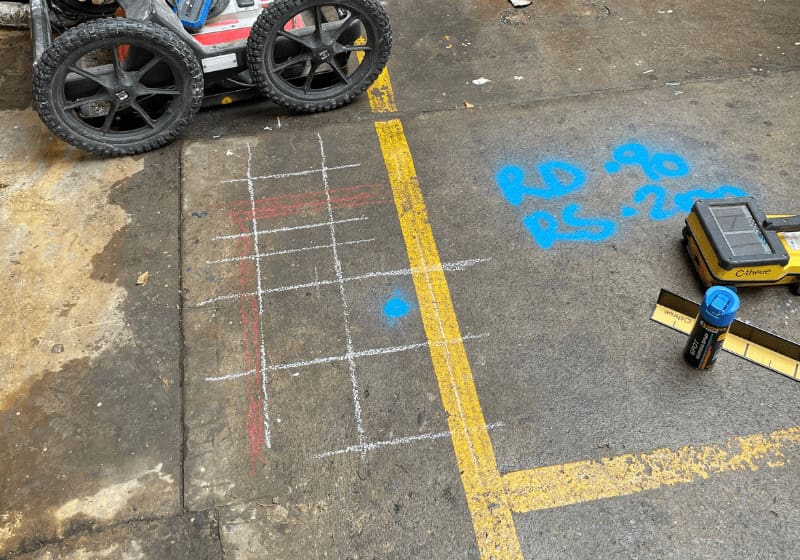
Our NULCA certified technicians scan on a marked grid with high-frequency GPR built for concrete, using Leica and Mala antennas, and confirm metallic conduits with EMI. Post-tension tendons and live conduits are marked in a different colour from rebar, with depths written on the slab, so your cutting or coring location can be shifted or confirmed before anyone drills.
Findings are marked directly on the concrete and photographed. Where you need documentation, we provide scan images and CAD-compatible files for engineering or compliance use. Most small scans of a few core locations take one to two hours, and larger areas are quoted per site.
Recent work includes scanning for post-tension cables and embedded services on the M6 upgrade at Rockdale, and GPR imaging across slab zones at Western Sydney Airport. Bookings for concrete scanning in Sydney are taken 24/7, including night shifts and emergency callouts.
North of Sydney, we scan commercial, strata and industrial slabs from Gosford to Tuggerah through our Central Coast concrete scanning service.
Planning to cut, core or drill? Call 1300 778 923 or send us your site details and we will scan the slab before anyone breaks into it.